

Should you upgrade your old Ryzen to a new Ryzen 5000? - bankstonnonon1970

Gordon Mah Ung
Intel users aren't the only ones jealous of the gobsmacking performance of AMD's new Ryzen 5000. Those on old versions of Ryzen are probably green with envy overly.
Before you wade into the scrum of trying to buy one of AMD's hot new Ryzen 5000 chips, though, you should know whether it's really Worth upgrading or not.
Generation-terminated-generation upgrades are rarely ever worth it, whether you're talking CPUs or GPUs. To see if that applies present, we collected CPU performance figures from chips we've tested internally and supplemented them. This means they're a teentsy less precise, but because the test, Cinebench R15, is mostly a pure compute test, information technology's microscopic sufficient for this purpose.
Cinebench is a 3D model test, which doesn't mean it leave map instantly to, say, browsing, Office operating theater most light work. But it's still an easy way to fancy just how often computing power is in a PC. A higher score in Cinebench generally tracks with total performance increases.
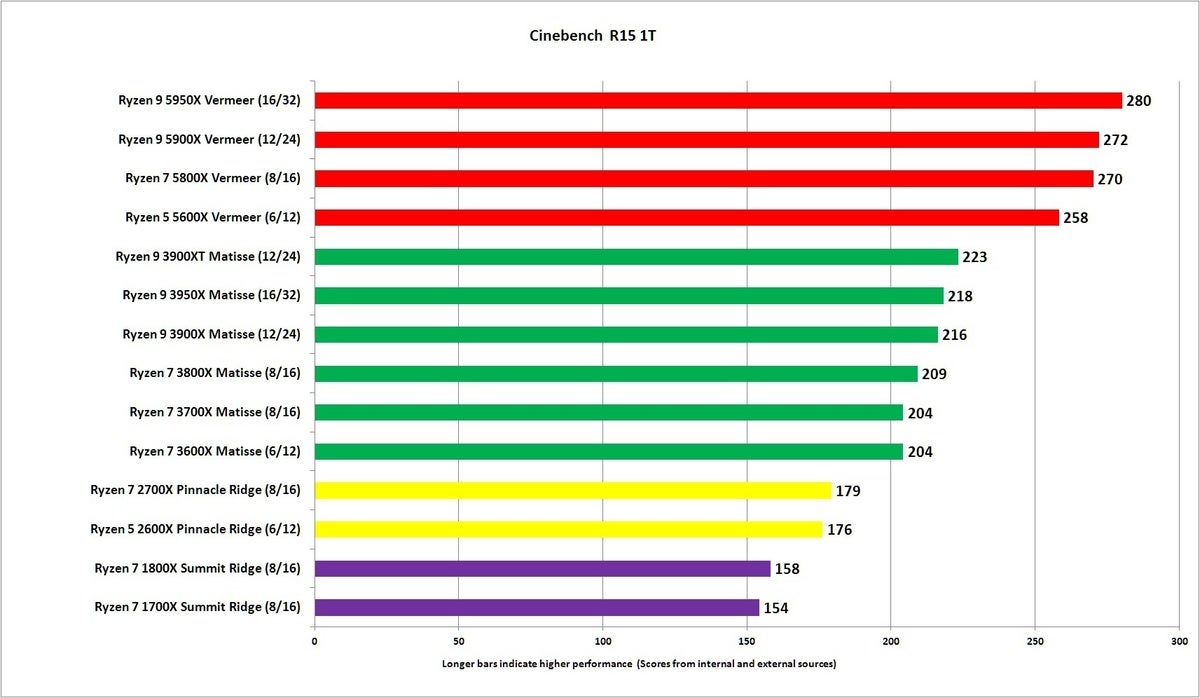
First we'll look at single-rib operation across the four generations of Ryzen CPUs. Quite than multi-core, which might give you a better performance in 3D modelling, video editing, and some other CPU-qualifier workstation apps, one-man-threaded performance tends to prescribe reactivity of about Office (but not all) tasks, browse, and near (but not all) photoediting tasks, along with other lighter-duty bring off.
In the charts that follow, we've color-coded the four different Ryzen serial for easier reading:
- 1st multiplication (Ryzen 1000): Purple
- 2nd generation (Ryzen 2000): Yellow
- 3rd generation (Ryzen 3000): Cat valium
- 4th propagation (Ryzen 5000): Ruddy
- (If you're questioning what happened to the 4000-series of screen background chips, record this.)
 IDG
IDG First we'll say AMD has made huge strides in single-threaded performance, from the originative scoop-of-generation Ryzen 7 1800X in 2017 to the best-of-contemporaries Ryzen 9 5950X in 2020. That's all but a recorded 82-percent performance increase. From the best of genesis Ryzen 7 2700X, you're sounding at a 56-percent performance increase. The best of generation Ryzen 9 3900XT cuts that down to 25 percent, which is standing a big boost in generation-all over-generation single-threaded performance.
Big, long bars are chill to facial expression at, but single-threaded execution tends to be harder to comprehend in de facto experience. If, for example, you're squirting a chore in Microsoft Office that takes 3 seconds on a 1000-series Ryzen, will you really look like your humankind was rocked if it takes 1.5 seconds with a 5000-serial publication Ryzen? On the other hand, if it's a painful 30-second file conversion using few old bequest application that you can cut down to 15 seconds—then yes, it might be worth it to you.
For a lot of people using 3000-series Ryzen parts, moving to a new Ryzen 5000 for mostly single-threaded tasks volition yield better public presentation, but probably not the best return happening investment for a direct upgrade. A 2000-series Ryzen surgery 1000-user however, leave definitely yield very good returns from an upgrade.
Simply what around gaming?
The one big caveat to completely of this is play performance. With the Ryzen 5000, AMD has finally pulled in front of Intel in gaming. You may see anywhere from 5- to 20-percent best gaming performance going from a 2000-series partly to Ryzen 5000. You might see that in a few games with Ryzen 3000, too.
If you'atomic number 75 gear up to jump with with both feet from hearing this news, keep in mind that you need to pair the CPU with a very fast and very valuable GPU, and also play at lower resolutions with the aim of high refresh rates. That's because at high resolutions, almost games are bottlenecked by the graphics card, and the Central processing unit's influence along courageous performance decreases greatly.
Need, for example, a PC utilised for gaming 80 percent of the time, configured for playacting games at 4K resolution. If we were to configure information technology with a Ryzen 7 2700X and GeForce RTX 3080, or a Ryzen 7 5800X with a GeForce RTX 3070, the latter is the preferred configuration most of the time.
Should you upgrade your Ryzen for multi-core functioning?
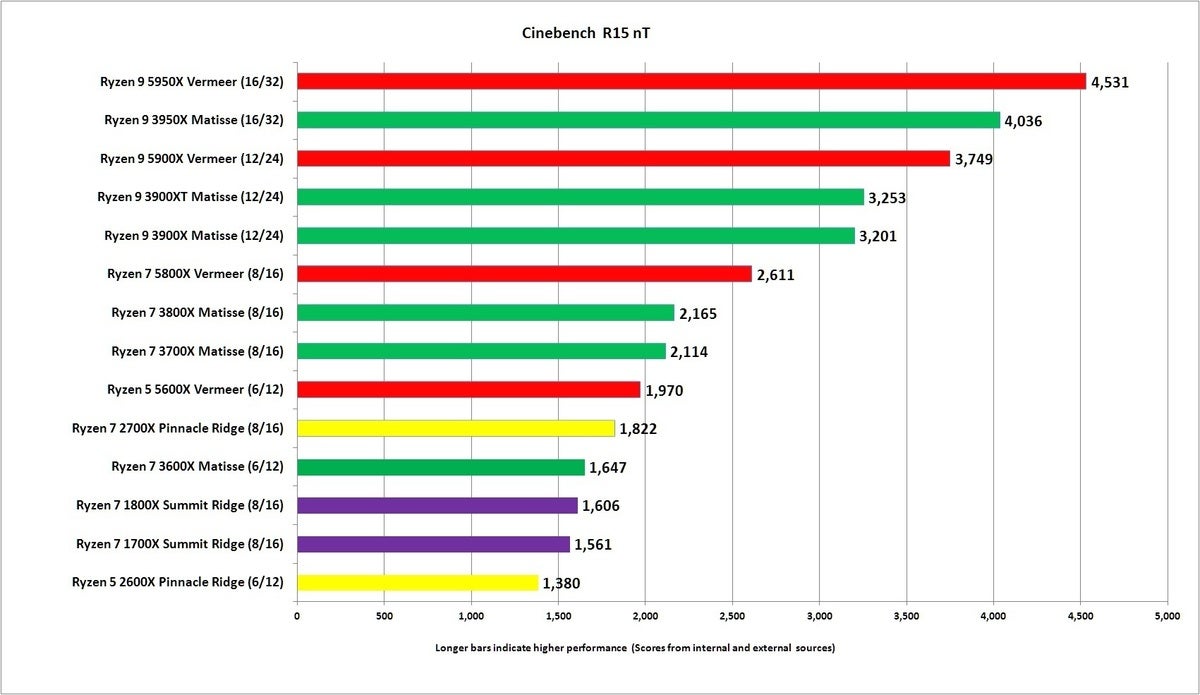
Another big reason to view upgrading your Ryzen is multi-pith performance. That's the house Ryzen was built on, and we can say there is a great deal of value to doing an upgrade—if you'Ra coming from the right home.
Cinebench's multi-core benchmark results, for example, suggest the performance you could see in similar heavy-duty applications such as 3D modeling, video editing, and most workstation-story tasks that tend to plate well with increases in core count.
 IDG
IDG If you consider the chart from a space, you can see the impressive strides AMD has made with every generation. From the original base-breaking Ryzen 7 1800X in 2017 to the Ryzen 9 5950X in 2020, multi-core performance has jumped by 182 percent.
Unequal single-threaded tasks, where flush a 20-percent increase likely won't be felt up just about of the time, multi-core tasks be given to read longer, and the yields from accretive core count is to a greater extent observable.
If, e.g., you're doing an cipher on your 8-core Ryzen 7 1800X and the encoder scales with core count (every bit most modern ones do), you could potentially cut an encode from 2 hours to 45 minutes by moving to a new 16-core Ryzen 9 5950X. If you'rhenium doing 3D modelling, the speedups would typically exist huge besides.
And then yes, more often than not moving to the latest Ryzen 5000 will yield Brobdingnagian returns. Before you start your hunt, realize that while Ryzen 5000 is impressive, the returns aren't as impressive if you already have a high-center count chip.
For example, if you give birth a 16-burden Ryzen 9 3950X, moving to a 16-core Ryzen 9 5950X isn't going to rock your world. But passing from a 8-nub Ryzen 7 3700X to a 12-marrow Ryzen 9 5900X will so give you that multi-core zing you're looking.
Related stories:
- Ryzen 5000 review: The best consumer CPU we've seen
- 5 reasons Ryzen 5000 needs to be your next CPU
- How to take in sure your motherboard is ready for Ryzen 5000
- Why AMD calls it Ryzen 5000 instead of Ryzen 4000
Note: When you purchase something after clicking links in our articles, we may earn a small commission. Scan our affiliate link insurance for more details.
One of founding fathers of hardcore tech reporting, Gordon has been covering PCs and components since 1998.
Source: https://www.pcworld.com/article/393713/should-you-upgrade-your-old-ryzen-to-a-new-ryzen.html
Posted by: bankstonnonon1970.blogspot.com
0 Response to "Should you upgrade your old Ryzen to a new Ryzen 5000? - bankstonnonon1970"
Post a Comment